
Reconstruction Methodology
FRAMe Project Scientific Methodology for the Research Quality functional reconstructions of the Antikythera Mechanism
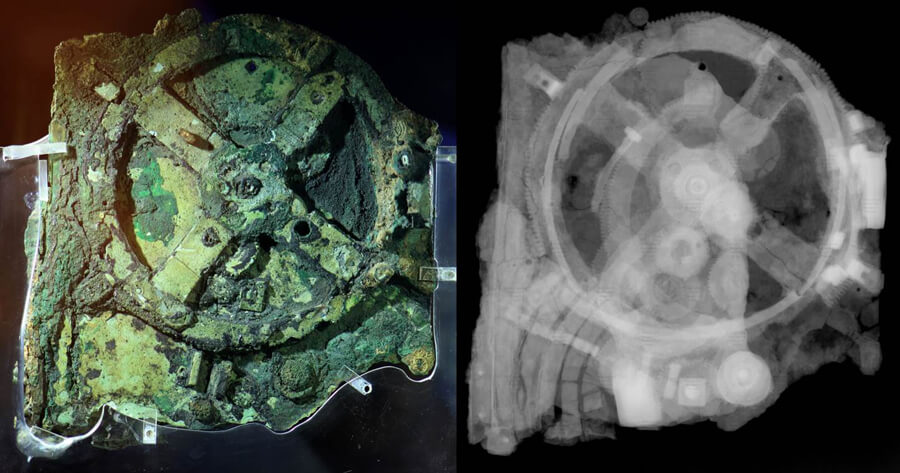
The Antikythera Mechanism Research project X-Ray Raw Volume data
After our asking for the use permission of the X-ray RAW Volumes of the AM fragments, the leaders of the Antikythera Mechanism Research Project Profs. M.Edmunds, J.Seiradakis and X.Moussas, provided us X-Ray Raw Volume data of the Mechanism’s fragments.
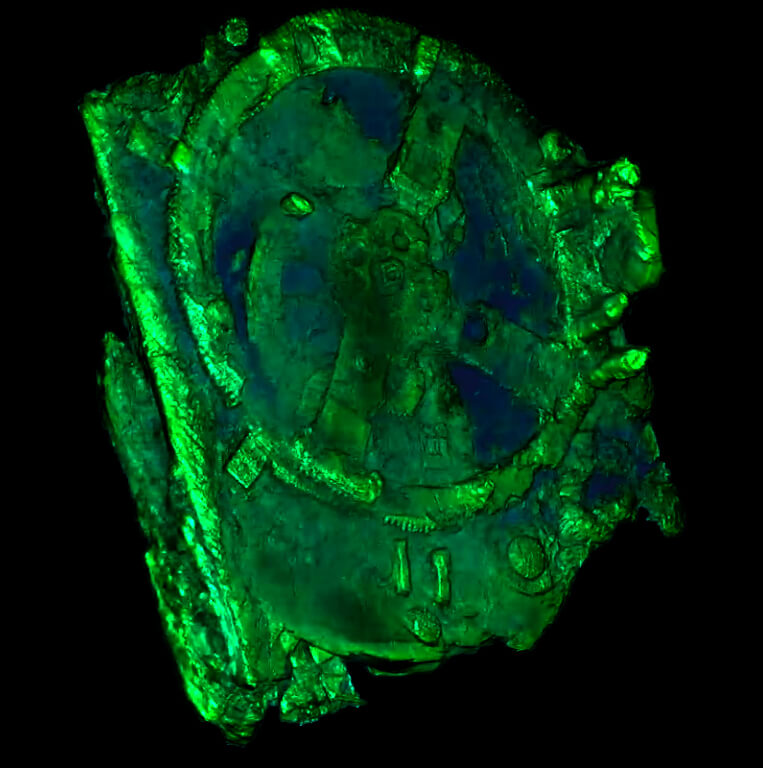
3D Generated reconstructions of the Fragments using the X-Ray Raw Volumes
We processed the volumes and we re-generated the 3D reconstructions and the X-ray tomographies (at best as much possible orientation) via the proper software.
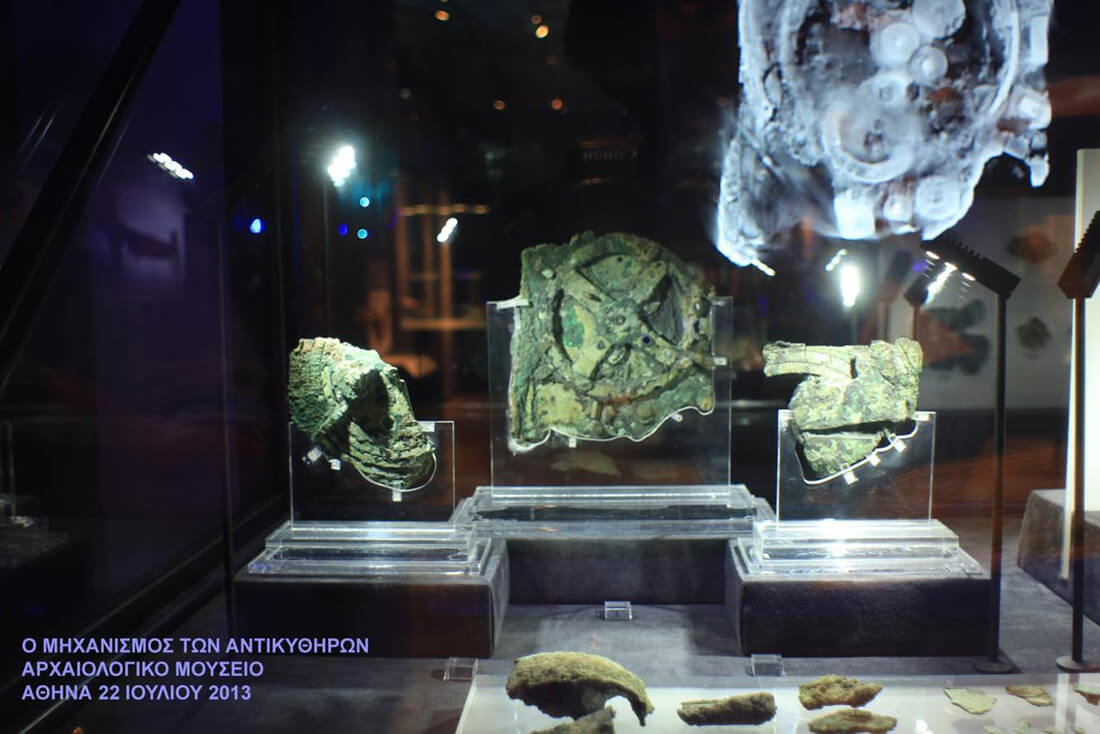
The 82 large and small Fragments of the Antikythera Mechanism
Today, the Antikythera Mechanism is partially preserved in large and small fragments, and a significant part is missing; a Scientific Methodology is needed for the investigation and the reconstruction of the Antikythera Mechanism.
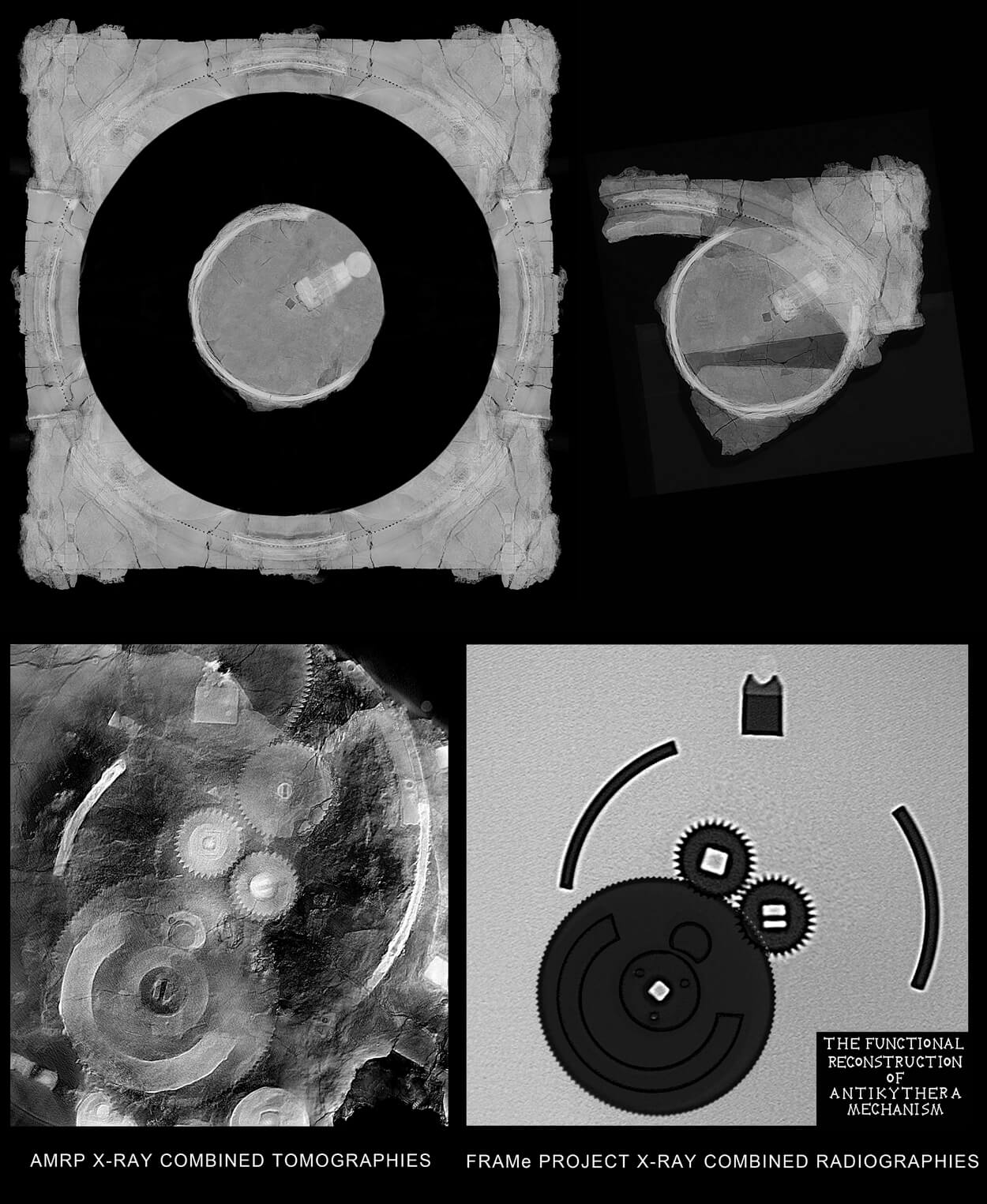
Digital reconstructions of the fragments’ lost parts
After extended analysis of the dimensional calibrated tomographies, in cooperation to the visual photographs of the fragments, we digitally re-designed/completed lost parts of the fragments.
The FRAMe Project Protocol for the Research Quality bronze reconstruction of Antikythera Mechanism
For the reconstruction of a Research Quality bronze replica of the Antikythera Mechanism, we applied a strict protocol of fourteen parameters in order to approach – as much as possible – the original artifact. Our bronze reconstructions of AM were achieved according strictly to the following protocol:
Protocol of Mandatory Parameters for a Research Quality bronze reconstruction of Antikythera Mechanism
| 1 | Must be based on the CT scans and the visual photographs of the fragments. |
| 2 | Without any change of the preserved parts’ dimension and ordered position (taking into account the Symmetry on the design, as also the deformation and the displacement of the parts). |
| 3 | Without making holes where nothing exists on the ancient original prototype. |
| 4 | A hypothetical part cannot be adapted in a place where there is no indication of a missing component. |
| 5 | Keeping/repeating the Personal Constructional Characteristics of the ancient Craftsman. |
| 6 | Without any use of modern mechanical parts (screws, bolts, grub screws etc.). |
| 7 | Having gear thickness around 2mm and without hubs (local central increment of the thickness). |
| 8 | The teeth of the gears must be in triangular teeth shape (not modern involute shape). |
| 9 | Using a simple bronze alloy material for the bronze gears, bronze shafts and bronze axes (and not special or steel or other ferrous alloys). |
| 10 | Using the minimum hypothetical parts’ addition. |
| Scientific Methodology | |
| I | The hypothetical considerations (e.g. units of a lost scale) are approved after checking the consequences, the impacts and the functionality of this hypothesis directly on the use and the results, retracted by the use a Research Quality functional model. |
| II | Any hypothetical operation of the Antikythera Mechanism must be supported by the experiment or by a bronze functional reconstruction. |
| III | If a hypothesis disagrees with the experiment it is wrong. |
| IV | Theoretical approaches, non-experimentally confirmed, cannot be accepted for DeFacto and they cannot be used in order to reject other hypotheses supported by the experiment. |
Note that any deviation from the fourteen parameters can strongly alter the mechanical status of the Antikythera Mechanism system, leading to different mechanical behavior, different results and conclusions and finally to incorrect considerations.
Any hypothesis on the Mechanism must be represented by the experimental bronze reconstructions, see R. Feynman’s lecture The Key to Science, The Scientific Method – Guess, Compute, Compare https://www.youtube.com/watch?v=NmJZr6FGJLU).
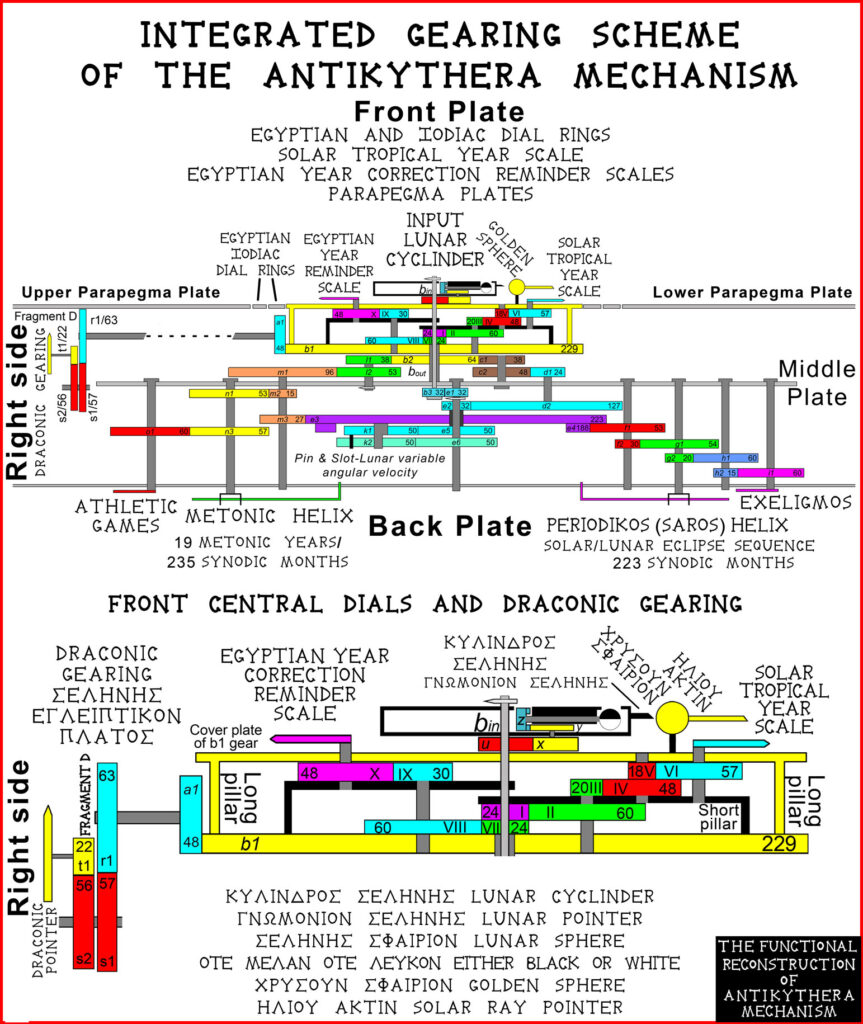
Voulgaris, A., Mouratidis, A., Vossinakis, A., and Roumeliotis M., (2026), “Is There Something Missing from the Antikythera Mechanism? Was It a Mechanical Planetarium–Positioner? Or a Luni-Solar Time Calculator Device? Reconstructing the Lost Parts of b1 Gear and Its Cover Disc”, Heritage 9(3): 95.
https://www.mdpi.com/2571-9408/9/3/95